


Plate Making & Ancillary Equipment


Frequently Asked Questions
What ancillary equipment is essential for setting up an efficient pad printing production cell?
Running a consistent industrial pad printing line requires pre-press plate making, component surface preparation, and curing systems. Core ancillaries include Computer-to-Plate (CTP) laser engravers or UV exposure units for cliché preparation, corona or atmospheric plasma treaters to promote ink adhesion on low surface energy plastics, custom CNC-machined holding jigs, and hot air or UV conveyor drying tunnels.
How do Kent Computer-to-Plate (CTP) laser engraving systems compare to traditional chemical etching?
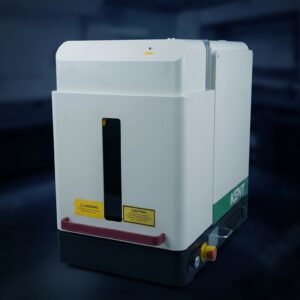
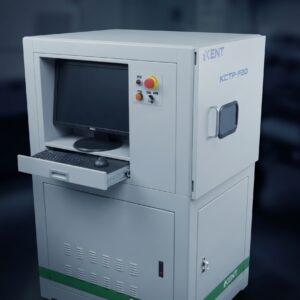
Kent CTP fiber laser systems (such as the KCTP-F10 and KCTP-F20) create printing clichés digitally direct from vector artwork (.ai, .dxf) in minutes. This completely eliminates film positives, darkrooms, chemical developing, acid etching, and hazardous waste disposal. Digital laser engraving delivers uniform cell depth, repeatable ink laydown, and screen counts up to 250–350 lpi for half-tones and fine technical graphics.
What is the difference between the Kent KCTP-F10, F10 Extended, and KCTP-F20 laser plate makers?
-
Kent KCTP-F10 (Economy): A compact, air-cooled 20W benchtop system built on a rigid granite platform, ideal for standard plates up to 100 x 250 mm with a 100 x 100 mm engraving area and resolution up to 250 lpi.
-
Kent F10 Extended Format: Configured for larger tooling setups, expanding the standard engraving window up to 150 x 150 mm on extended 150 x 350 mm cliché plates.
-
Kent KCTP-F20 (High Precision): A heavy-duty, freestanding industrial unit featuring an IPG 20W fiber laser and proprietary Kent VR.01 software. It supports resolution up to 350 lpi (175 lpi for 4-colour process half-tones), accommodates thin green plates as well as 10mm hardened steel plates, and offers optional large-format platforms up to 150 x 350 mm and 200 x 600 mm.
Why is surface pre-treatment (corona or plasma) necessary before pad printing plastics?
Non-polar polymers such as polypropylene (PP), polyethylene (PE), and polyacetal (POM) possess naturally low surface energy (dyne levels below 34 dynes/cm), causing ink to bead up and fail cross-hatch adhesion tests. Corona or plasma pre-treatment temporarily oxidizes the plastic surface, raising surface energy above 44–48 dynes/cm to ensure molecular bonding with 1-component or 2-component pad printing inks without requiring hazardous chemical primers.